MATH 5345H: Honors: Introduction to Topology — Fall 2026
Links
- Canvas
- University of Minnesota Fall 2026 academic calendar
- University course catalog entry
- Lecture Notes
Course Details
- Class meetings: Monday and Wednesday, 12:20–2:15 PM, Vincent Hall 1
- Credits: 4
- Instructor: Erkao Bao
- Office: Vincent Hall 356
- Email: bao@umn.edu
- Office hours (temporary): 2:15pm - 3:15pm Monday and Wednesday, or by appointment.
- Course management: Announcements, assignments, submissions, and schedule updates are posted on Canvas.
- Textbook: Topology, 2nd edition, by James R. Munkres. Any printing of the second edition is fine.
Course Description
MATH 5345H is a rigorous honors introduction to general topology. We begin with set-theoretic and logical foundations, then build up topological and metric spaces: bases, subspaces, products, quotients, closed sets, limit points, continuity, and homeomorphisms. From there we study connectedness, compactness, countability, and the separation axioms, including major theorems such as the Urysohn metrization theorem, the Tietze extension theorem, and the Tychonoff theorem. The last part of the course turns to complete metric spaces, function spaces, and a first look at homotopy of paths, which is the entry point to the fundamental group.
Abstract arguments and concrete examples get equal weight. Counterexamples drawn from geometry, algebra, analysis, and number theory are a recurring theme, since knowing which hypotheses can be dropped is as important as knowing the theorems. As an honors course, this class moves quickly and asks you to write a substantial amount of independent mathematics.
Prerequisites
One of MATH 2263, MATH 2374, or MATH 2573; and enrollment in or completion of MATH 2283, MATH 2574, or MATH 3283. You should already be comfortable reading and writing proofs.
Course Goals
By the end of the semester you should be able to:
- Construct and compare topologies, and decide whether a given map is continuous or a homeomorphism.
- Analyze how topological properties behave under subspaces, products, quotients, and continuous images.
- Use connectedness, compactness, countability, and the separation axioms to prove structural results.
- Relate completeness, compactness, and convergence in metric and function spaces.
- State the definition of homotopy of paths and explain how it leads to the fundamental group.
- Write precise, readable proofs, and evaluate other arguments for correctness, clarity, and completeness.
Mathematical Writing
This course is not officially writing intensive, but mathematical writing sits at its center. A proof has to be logically correct, and it also has to convince a reader. Homework and exams are graded on organization, precision, use of notation, and explanation of the main idea, not only on whether the final conclusion is right. Expect feedback on exposition alongside feedback on correctness.
Course Format
We meet twice a week for a mix of lecture, discussion, worked examples, and proof development in class. Do the assigned reading before the corresponding meeting; the pace assumes it.
- First class meeting: Wednesday, September 9, 2026
- Thanksgiving holiday: Thursday–Friday, November 26–27, 2026 (no Monday or Wednesday meeting falls on these dates)
- Last day of instruction: Wednesday, December 16, 2026 (Exam 2 is held during this meeting)
Academic Support
Study groups help in a course like this one. Office hours are the right place for questions about concepts, proof strategy, and mathematical writing, and you are welcome there even when you do not have a specific question prepared. The Tutoring & Academic Success Center offers peer tutoring and related support.
Assessments
Homework
Problem sets are normally posted weekly on Canvas and submitted through Canvas. A selected subset of problems may be graded in detail. Unless announced otherwise, assignments are due at 11:59 PM on the date listed in the schedule. The lowest problem-set score is dropped. There is no extra credit.
Exams
- Exam 1: Wednesday, October 14, 2026, 12:20–2:15 PM, in class. Covers Munkres §§1–21.
- Exam 2: Wednesday, December 16, 2026, 12:20–2:15 PM, in class. Covers Munkres §§22–51. Exam 2 is not cumulative; it covers only the material after Exam 1.
There is no final exam. Both exams are held in person and proctored. Because AI tools have made take-home examinations unworkable, no part of either exam may be completed outside the exam room. Books, notes, electronic devices of any kind, internet access, AI tools, and collaboration are all prohibited during exams. Any further details of format will be announced on Canvas.
Grading Policy
Your numerical score is computed as follows:
- Homework: 30%
- Exam 1: 35%
- Exam 2: 35%
The letter grade is then the more favorable of two scales: a fixed scale (90: A range, 80: B range, 65: C range, 50: D range) and an approximate class distribution (top 25%: A range; next 30%: B range; next 35%: C range; remaining 10%: D/F). Plus and minus grades may be used. The curve can only help; it will never lower a grade earned on the fixed scale.
Course Policies
Attendance
Attendance is not a separate graded component, but regular attendance and participation are expected, and the material is hard to reconstruct from the textbook alone. You are responsible for announcements, assigned reading, and anything covered while you are away. Excused absences and makeup work follow University policy.
Collaboration and Academic Integrity
Collaboration on homework is encouraged. Talking through a problem with classmates is one of the best ways to learn topology. What you submit, however, must be written independently, in your own words, and must list your collaborators and any outside sources you consulted. Copying a solution, sharing a completed write-up, and submitting work produced by someone else are all prohibited. Collaboration is never permitted on exams. See the section below for how these rules apply to AI.
Use of AI
Arnold compared mathematics to mushroom hunting: what you see above ground is only the fruit, while the real organism is underground. “The upper part of the mushroom corresponds to theorems that you see,” he wrote — the problems, mistakes, and ideas that connect them stay buried. (V. I. Arnold, From Hilbert’s Superposition Problem to Dynamical Systems.)
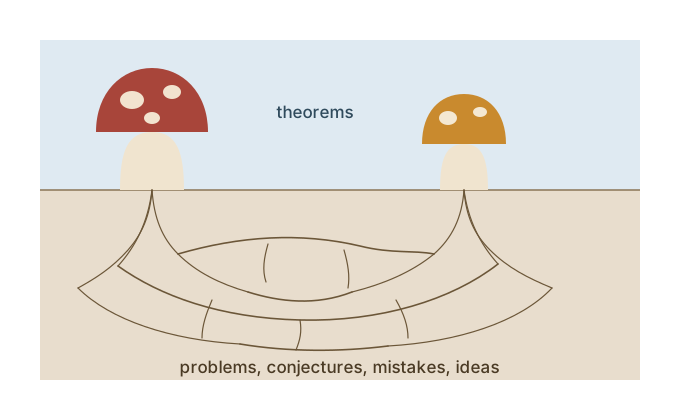
AI hands you the mushroom. The part that makes you a mathematician grows underground. You are welcome to use AI in this course, subject to the guidelines below.
Recommended uses. Ask AI to explain a definition or theorem in different words, to supply examples and counterexamples, to check a computation, to suggest what technique a problem might call for, or to tell you where an argument of yours goes wrong. Working through a problem with AI one step at a time — where you decide the next step and use it to test your reasoning — is far more valuable than reading a finished solution.
Discouraged uses. Please don’t paste an entire homework problem in and ask for the solution, especially before you have made a serious attempt yourself. If you are not stuck on a concept, the best thing you can do is work the problem without help. When you do use AI, use it to get unstuck, not to get finished.
Your responsibility. Whatever you submit is yours. You are accountable for its correctness, you must understand every step of it, and you should be able to reproduce and defend the argument without assistance. AI output is frequently wrong in ways that look plausible — verify everything.
Exams. Both exams are in person and closed-book. AI tools of any kind are prohibited, as are notes and electronic devices. Prepare accordingly: the skills the exams test are the ones you build by working problems yourself.
Late Work and Make-up Exams
Late homework is accepted only for compelling reasons. Contact me as soon as you can, preferably before the deadline. The dropped problem set is meant to absorb an ordinary missed or unusually weak assignment, so please save it for that. Make-up exams are generally not given. A missed exam may be accommodated only for a compelling excused circumstance and with prompt communication; get permission in advance whenever that is possible.
Calculators and Electronic Devices
Calculators are neither required nor permitted on exams. Personal electronic devices may be used in class for course-related purposes only, and must not disrupt instruction or other students.
Incompletes
An incomplete will be considered only when substantial course work has been completed, you are unable to finish for documented reasons beyond your control, and a written completion agreement is made in accordance with University policy.
Drops and Withdrawals
You are responsible for reviewing the University’s drop/add deadlines and withdrawal rules.
Course Schedule (tentative)
The schedule is a good-faith plan and may be adjusted to match the pace and needs of the class; changes will be announced on Canvas. Section numbers refer to Munkres, Topology, 2nd edition. The Fall 2026 term begins Tuesday, September 8, so the first meeting of this Monday–Wednesday course is Wednesday, September 9. The schedule covers Part I (General Topology, §§1–50) in full apart from the starred optional sections, plus §51, the opening section of Part II.
| Week | Date | Day | Topic |
|---|---|---|---|
| 1 | Sep 9 | Wed | Course overview and proof writing; sets and functions (§§1–2) |
| 2 | Sep 14 | Mon | Relations and the real numbers (§§3–4) |
| 2 | Sep 16 | Wed | Cartesian products; finite, countable, and uncountable sets (§§5–7) |
| 3 | Sep 21 | Mon | Topological spaces and standard examples (§12) |
| 3 | Sep 23 | Wed | Bases, subbases, and comparison of topologies (§13) |
| 4 | Sep 28 | Mon | The order topology and the finite product topology (§§14–15) |
| 4 | Sep 30 | Wed | Subspaces, closed sets, closure, and limit points (§§16–17) |
| 5 | Oct 5 | Mon | Continuity, homeomorphisms, and the pasting lemma (§18) |
| 5 | Oct 7 | Wed | Arbitrary products and coordinate maps (§19) |
| 6 | Oct 12 | Mon | Metric topologies, metrizability, and sequences (§§20–21) |
| 6 | Oct 14 | Wed | Exam 1 |
| 7 | Oct 19 | Mon | The quotient topology and identification spaces (§22) |
| 7 | Oct 21 | Wed | Connectedness and connected subspaces of the real line (§§23–24) |
| 8 | Oct 26 | Mon | Components, path components, and local connectedness (§25) |
| 8 | Oct 28 | Wed | Compactness and the finite intersection property (§26) |
| 9 | Nov 2 | Mon | Compact subsets of Euclidean space; Heine–Borel and related results (§27) |
| 9 | Nov 4 | Wed | Limit point compactness and sequential compactness (§28) |
| 10 | Nov 9 | Mon | Local compactness and the one-point compactification (§29) |
| 10 | Nov 11 | Wed | Countability and separation axioms; examples and counterexamples (§§30–31) |
| 11 | Nov 16 | Mon | Normal spaces and the Urysohn lemma (§§32–33) |
| 11 | Nov 18 | Wed | The Urysohn metrization theorem and the Tietze extension theorem (§§34–35) |
| 12 | Nov 23 | Mon | The Tychonoff theorem and compactness of products (§37) |
| 12 | Nov 25 | Wed | Local finiteness and the Nagata–Smirnov metrization theorem (§§39–40) |
| 13 | Nov 30 | Mon | Paracompactness and the Smirnov metrization theorem (§§41–42) |
| 13 | Dec 2 | Wed | Complete metric spaces; compactness in metric spaces (§§43, 45) |
| 14 | Dec 7 | Mon | Pointwise and compact convergence; the Ascoli theorem (§§46–47) |
| 14 | Dec 9 | Wed | Baire spaces and an introduction to dimension theory (§§48, 50) |
| 15 | Dec 14 | Mon | Homotopy of paths; course review (§51) |
| 15 | Dec 16 | Wed | Exam 2 |
Required University Policy Statements
The University of Minnesota Recommended Policy Statements for Syllabi are incorporated here by reference. They cover the Student Conduct Code, personal electronic devices, scholastic dishonesty, excused absences and makeup work, appropriate use of class notes and course materials, University grading scales, sexual misconduct, equity and equal opportunity, disability accommodations, mental health and stress management, and academic freedom and responsibility.
Please review the current statements in full: Recommended Policy Statements for Syllabi.
Students seeking disability-related accommodations should contact the Disability Resource Center and share a current accommodation letter with me as early in the semester as possible.