MATH 8302: Differential Topology — Fall 2026
Time
MWF, 10:10–11:00 AM
Location
Vincent Hall 6
Instructor
Erkao Bao
Office
Vincent Hall 356
Zoom Meeting ID
Office Hours (temporary)
12:15pm - 2:15pm Friday, or by appointment
Course Summary
This course covers smooth manifolds, tangent spaces, embeddings and immersions, Sard’s theorem, the Frobenius theorem, differential forms, integration on manifolds, curvature, and the Gauss–Bonnet theorem. Time permitting, we will also discuss de Rham theory and duality on manifolds.
Prerequisites
Basic point-set topology and multivariable calculus. These are essential; the course assumes fluency with both from the first week.
Course Goals and Objectives
By the end of the course, students should be able to:
- Work confidently with smooth manifolds, smooth maps, and tangent spaces.
- Distinguish embeddings from immersions and apply Sard’s theorem and transversality arguments.
- State and use the Frobenius theorem, and compute with differential forms and integration on manifolds.
- Explain the role of curvature and prove and apply the Gauss–Bonnet theorem.
- (Time permitting) Use de Rham cohomology and Poincaré duality on manifolds.
Course Format
The course meets in person on Mondays, Wednesdays, and Fridays. A day-by-day plan will be maintained on Canvas and updated as the semester progresses; the order and pace of topics may change, so no fixed weekly schedule is given here.
- First class meeting: Wednesday, September 9, 2026
- Last class meeting: Wednesday, December 16, 2026 (Exam 2)
Course Links
Textbook
No textbook is required. Lectures will follow my own notes, which grew out of Ko Honda’s lecture notes; I plan to typeset them in LaTeX and post them on Canvas as the semester goes on.
Optional references:
- Lee, Introduction to Smooth Manifolds
- Warner, Foundations of Differentiable Manifolds and Lie Groups
- Peter Petersen’s notes
- Milnor, Topology from the Differentiable Viewpoint
- Bott & Tu, Differential Forms in Algebraic Topology
Homework
Homework will normally be assigned weekly on Canvas. Collaboration is encouraged, but write up your solutions on your own and in your own words.
Exams
There are two exams. Both are held in person during the regular lecture period in Vincent Hall 6, and both are closed-book: no notes, electronic devices of any kind, internet access, AI tools, or collaboration. Because AI tools have made take-home examinations unworkable, no part of either exam may be completed outside the exam room.
- Exam 1: Friday, October 30, 2026, 10:10–11:00 AM
- Exam 2: Wednesday, December 16, 2026, 10:10–11:00 AM
Exam 2 is not cumulative; it covers the material after Exam 1. There is no separate final examination during finals week.
Grading Policy
- Homework: 30%
- Exam 1: 35%
- Exam 2: 35%
Course Policies
Attendance
Regular attendance is expected. Attendance is not graded separately, but you are responsible for all announcements and material presented in class and posted on Canvas.
Collaboration and Academic Integrity
Collaboration on homework is encouraged. Exams are closed-book, in person, and individual: no notes, devices, outside help, or AI assistance. All work must comply with the University Student Conduct Code and the University’s scholastic-integrity policies.
Use of AI
Arnold compared mathematics to mushroom hunting: what you see above ground is only the fruit, while the real organism is underground. “The upper part of the mushroom corresponds to theorems that you see,” he wrote — the problems, mistakes, and ideas that connect them stay buried. (V. I. Arnold, From Hilbert’s Superposition Problem to Dynamical Systems.)
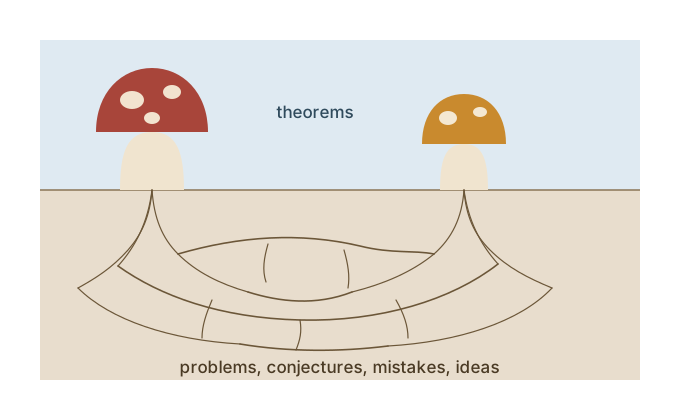
AI hands you the mushroom. The part that makes you a mathematician grows underground. You are welcome to use AI in this course, subject to the guidelines below.
Recommended uses. Ask AI to explain a definition or theorem in different words, to supply examples and counterexamples, to check a computation, to suggest what technique a problem might call for, or to tell you where an argument of yours goes wrong. Working through a problem with AI one step at a time — where you decide the next step and use it to test your reasoning — is far more valuable than reading a finished solution.
Discouraged uses. Please don’t paste an entire homework problem in and ask for the solution, especially before you have made a serious attempt yourself. If you are not stuck on a concept, the best thing you can do is work the problem without help. When you do use AI, use it to get unstuck, not to get finished.
Your responsibility. Whatever you submit is yours. You are accountable for its correctness, you must understand every step of it, and you should be able to reproduce and defend the argument without assistance. AI output is frequently wrong in ways that look plausible — verify everything.
Exams. Both exams are in person and closed-book. AI tools of any kind are prohibited, as are notes and electronic devices. Prepare accordingly: the skills the exams test are the ones you build by working problems yourself.
Make-up Exams and Late Work
If a compelling circumstance prevents you from meeting a deadline or taking an exam as scheduled, contact me as soon as possible. Any revised arrangement will follow University policy.
Incompletes
An incomplete will be considered only in circumstances permitted by University policy, and only with a written plan for completing the remaining work.
Course Schedule
A detailed day-by-day plan will be maintained on Canvas; no weekly schedule is included in this syllabus.
Required University Policy Statements
The University of Minnesota’s Recommended Policy Statements for Syllabi are incorporated here by reference. They address the Student Conduct Code, scholastic dishonesty, excused absences and makeup work, appropriate use of class notes and course materials, University grading scales, sexual misconduct, equity and equal opportunity, disability accommodations, mental health and stress management, and academic freedom and responsibility.
Please review the complete, current statements in the University’s Recommended Policy Statements for Syllabi.
Students seeking disability-related accommodations should contact the Disability Resource Center and share a current accommodation letter with me as early in the semester as possible.